The Core Sessions 4-6 and Session 7
The Fourth Session
The fourth through sixth Rolfing sessions represent a change in the Rolfer's intention. The focus moves from the superficial fascial planes to what's called the body's "core." Rolfers define "core" structures as those that lie close to the spine and the body's midline; they are differentiated from the "sleeve," consisting of the shoulder and pelvic girdles, and the lateral structures of the legs.
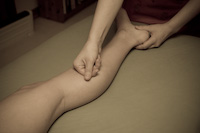
The agenda for the fourth session is deceptively simple, and the session may actually take less time than those which come before. The inside of the legs, from the ankles to the pelvic floor, is treated, followed by some organizing of the back and neck. The goal of the session is to establish improved support for the structures that make up the pelvic floor. Although most of the work is on the legs, a client will also often feel a "lift" throughout the torso. The fourth Rolfing session seeks to establish an inner pillar from which the limbs can be hung. That is, the Rolfer wants to hang the body's "sleeve" from the supportive "core."
An additional benefit of this session is to free the nerves that monitor the lower inner leg and the arch of the foot. These sensory nerves gather data about the foot's position in space. If they are snagged in the fascia they will not properly trigger the motor nerves that control the arch. When they are freed, the arch will naturally regulate itself more appropriately. Then, the bones are able to align to provide improved support for the rest of the body.
Session 4 Movement Integration video
The Fifth Session
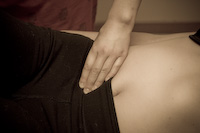
The fifth Rolfing session is a continuation of the fourth. It is recommended that not more than a couple weeks separate these sessions. Session Five addresses the relationship of the superficial abdominal muscles (such as the rectus abdominis) to the deeper muscles (the psoas and iliacus). Most people wrongly use the external stomach muscles to do the work of stronger, deeper lying muscles. During this session the Rolfer slowly lengthens and separates the outer structures to allow room for the inner structures to reassert themselves.
Dr. Rolf discovered an ingenious and remarkably safe method of working with these deep structures with a minimum of discomfort. Only a properly trained Structural Integration practitioner should attempt this method, but with the right education and experience, the fifth Rolfing session is often comfortable and enjoyable. Even people who generally dislike receiving work on the belly area, or who have had painful psoas work in the past, find this session to be relatively gentle yet effective.
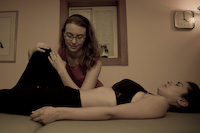
The psoas muscle is unique in the body because it is the only muscle that extends from the legs to the trunk (lumbar spine). All other muscles of the leg or trunk attach directly to some part of the pelvis. As a result, the proper training and toning of this muscles can help with back pain.
In
fact, sit-ups can trigger back pain and posture problems by shortening
the front of the body. The abdominal muscles or "abs" (transversus,
obliques, rectus abdominus) do the job of stabilzing the relationship
between the lower body and the upper body.
Exercises such as plank pose, side plank, leg lifts, and carrying heavy
weight while walking are safe ways to engage and strengthen the ab
support muscles. When the superficial muscles are stabilizing well, the
psoas and iliacus are free to do their job of moving the leg.
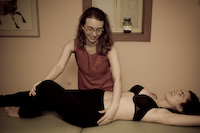
A healthy, active psoas muscle also helps other conditions. The nerve fibers located near the psoas become stimulated as the muscles respond to new movement. Menstrual cramping, constipation, and excessive gas may be lessened as a result. A satisfying feeling of the leg-trunk connection of these muscles often emerges as you learn to move your legs from the lumbar spine rather than from the hip joint.
The
fifth session may include gentle work on the organs, including the
digestive system, uterus and ovaries, and bladder and kidneys. The
connective tissues of organ
structures have a much higher ratio of elastin fibers than the
connective tissue of the muscles and bones, which are more
collagen-rich. This elastic quality means that the nature of organ work
is about unwinding the strain patterns rather than simply stretching
and pushing them into place. Work on the visceral structures is very
comfortable, slow-paced, and quite relaxing, almost meditative.
Session 5 Movement Integration video
Additional movement to support Session 5: External hip rotation, from
Kung Fu
The Sixth Session
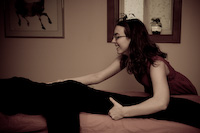
By this time in the sequence, both the Rolfer and the client have become aware of the balancing of the pelvic structure. As the body becomes more symmetrical and organized around a vertical line, disparities between the right and left sides become less apparent. In the sixth session, this symmetry is enhanced and extended above and below the pelvic girdle.
The the term "posture" is often used to describe the results of Rolfing, but it's actually not right the right meaning. The Latin root of posture is "positus," meaning "to place, to put." Consequently, "good posture" usually implies the "placing" of the body into a position that is considered appropriate and balanced. The goal of the Rolf process in its sixth session, on the other hand, is to create a structure which rests on a well supported vertical core and demands a minimum effort to maintain. Rolfing focuses on the integration of human structures - not old-fashioned beliefs about stiff posture.
The
results of the sixth Rolfing session may be dramatic. A sense of "bigness" and space are reported, as
well as an ability to breathe through to the spine; that is, the spine
appears to undulate during respiration in a wavelike motion. People who
have decreased or eliminated chronic back pain through Rolfing sometimes
point to the sixth session as pivotal in their progress. Others, who
come suffering from anxiety, may also claim an easing of emotional
distress after this session.
Session 6 Movement Integration video
The Seventh Session
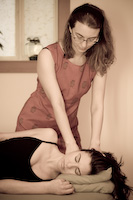
Session 7 Movement Integration video
Here's a brief free video for how to work on your own jaw muscles.
For a more comprehensive class, purchase the video for my Jaw Therapy at Home class.